Advise and Consent

Just saw my first Otto Preminger film, and my god it blew me away. It was Advise and Consent adapted by Wendell Mayes from the 1959 novel by Allen Drury. Like most Preminger films, it boasts an unbelievable ensemble cast. Was Charles Laughton's last role before he passed away. It's probably the only film I've seen that felt like three different films, in a row, in the best possible sense. Too many thoughts on it to write it out here, without delving into a half-baked essay, but some highlights: 

- incredibly progressive, (and at the time, I imagine, transgressive) featuring a subplot that becomes a central plot -- that was bold and powerful well ahead of its time (from what I can tell this was either negatively discussed or glossed over altogether by the critics at the time)

- Charles Laughton is truly unbelievable to watch, everything Frank Underwood wishes he could be

- Preminger offered both Martin Luther King Jr. and Richard Nixon roles in the film. MLK wanted to join but feared it'd distract from his civil rights causes. Nixon was his essential crotchety self and refused on the basis that it wasn't realistic enough. 

- Probably the only film that depicts jingoistic patriotism in a humanized light, not championing the perspective (in Laughton's character) but allowing you to see how it comes about, how it might be forgiven at least - after you neuter it. 

- Pure master class experience on how to adapt a novel to a screenplay, also how to control space and environment in your framing... among so much else. 

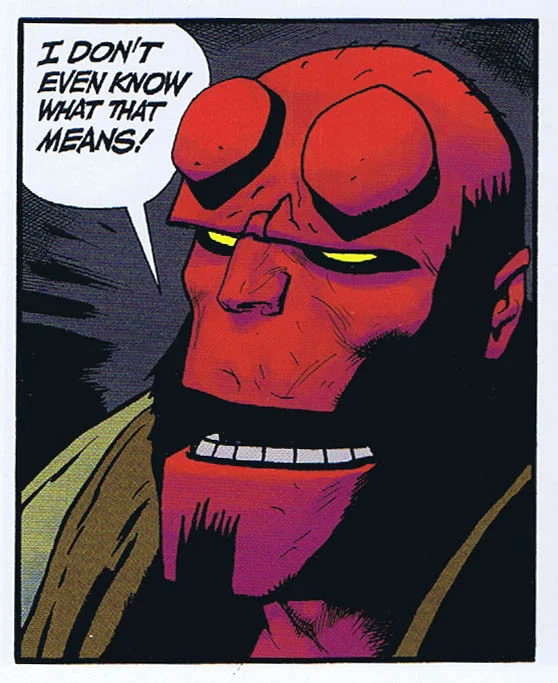
Alan Moore on Mignola & Hellboy

A beautiful quote of praise and also about nostalgia that I wanted to remember here:

"This, perhaps, is Hellboy’s greatest and least-obvious accomplishment: the trick, the skill entailed in this delightful necromantic conjuring of things gone by is not, as might be thought, in crafting work as good as the work that inspired it really was, but in the more demanding task of crafting work as good as everyone remembers the original being…. It’s not enough to merely reproduce the past. Instead we have to blend it artfully with how we see things now and with our visions for the future if we are to mix a brew as rich, transporting, and bewitching as the potions we remember from the vanished years”

Writer Influences (2018)

Just trying to do a bit of record keeping, for archaeological purposes. The writers who I'm reading / are affecting me right now: 

Jonathan Ames - Wake Up, Sir!You Were Never Really HereI Pass Like the Night, and I Love Your More Than You Know (Essays)

Mike Mignola - HellboyLord BaltimoreB.P.R.D

David Foster Wallace - Consider the Lobster (Essays/Articles)Infinite Jest (only the first 100 pages so far though they might as well be 400)

Thomas Pynchon - Inherent ViceBleeding EdgeThe Crying of Lot 49

P.G. Wodehouse - Stiff Upper Lip, Jeeves!

Mohsin Hamid - Exit West

Denis Johnson - Train Dreams, The Largesse of the Sea Maiden, Nobody Move (from earlier: Laughing MonstersTree of SmokeJesus' Son)

Laird Barron - The Beautiful Thing That Awaits Us AllThe CroningBlood Standard

Adrian McKinty - Dead I May Well Be

Kazuo Ishiguro - The Buried Giant (from earlier: Remains of the Day

There are several more I'm forgetting right now... will update later. 

Highline (HuffPo) Top Recs

Cataloging my top three stories to date from Highline, which is one of the better long-form journalism sites I've found yet. I think they appeal to me as a writer because they're incredibly narrative driven and specific -- they tell you as much about human nature as the specific environment they're uncovering (in no particular order): 

1) FML by Michael Hobbes. This one was viral, and shared on Facebook by people my age especially. 

2) Understanding Harvey by Emily Yoffe. Yoffe was the only reason I used to read Slate, she wrote an incredible advice column for them... and in this article she applies her psychology and writing skills towards understanding the emotional structures of sexual predators. 

3) The Disaster Tourist by Kent Russell. This one is just so goddamn entertaining - not to mention, equal parts terrifying and hilarious. It inspired me to write a horror feature about dark tourists awakening an evil, dormant force... working title, WHY US? Russell also wrote another great article before this one, They Burn Witches Here

Blurb from Novella

This paragraph came to me out of no where -- I think it'll go towards the end of the book, but I really don't have much context for it yet... 

"There was a moment then. As their bullets traveled far across the land, scarring unknown swaths of dirt. What might they be murdering out there, in the dirt? That moment, that thought – brought another vision riding on its haunches. A vision of me taking my rifle, the one leaning across my shoulder and resting its cool neck upon my own and turning it to aim at my own heart. It would be an awkward look, unwieldy to be sure, but I sensed that others had done it successfully. It would be a small target to eviscerate, but larger than the cricket or the worm that was just struck by one of their playful bullets out there in the wastes of the rest of the world that I cannot see. My heart, a small target indeed. What would it feel like? A bullet passing through, the softness of my muscle morphing it forever – from cylinder to mushroom, or would it—

“Eddy boy, what in the barreling fuck are you doing?”

In some meditative state, it seems, I had started turning the rifle towards myself. I couldn’t bring myself to answer him, so I had just laid the weapon down and started to walk away. Wished he had punched me. Or kicked me in the back as I left. But he didn’t. And the shooting continued."

What's the Best Medium?

I find myself thinking a lot about the goals of different writing mediums. When an idea comes to you -- do you always execute it in the best medium? Obviously most writers have their one or two formats: poetry, flash fiction, short fiction, novella, novels, memoir, essay, short or long form article, non-fiction book, documentary, monologues, plays, web-series, half-hour TV, one-hour TV, feature film... to name a few. 

For me a lot of these don't come into play. My writing attempts have been, in no particular order: poetry, most lengths of fiction (never completed a novella/novel though), essays, and one-hour TV (some features too). But many times while the idea is clear the best medium is not. This "valence" issue especially pops up for TV vs. feature screenplays -- but the question could apply to almost anything. 

With TV, I think it could ultimately be a question of character. Are these characters that will continue to live with their problems and conflicts, or does the character require a concise or definitive arc? Many times a plot can be broken and re-broken a thousand times to fit around the needs of the rest of the story. That's certainly something I'm trying to teach myself to do, since a lot of pilots end up feeling "cinematic" in all ways -- bad too, since it feels like it's just ended, how will this story continue indefinitely?  

But it also got me thinking about poetry, a medium I've attempted time and time again (go back all the way to the beginning of these posts for an example) but always feel I've failed at. I think, to justify a poem - the poet needs to examine the most basic building blocks of language itself. The smallest unit of writing needs to be self-aware. It's like physics -- the letters are quarks and the poet needs to be aware of every movement, every application. 

Whereas short fiction, well there's a little more breathing room, right? Each sentence needs to count, needs to do a ton of work, but ultimately it's about the story you weave - not the fabric with which its woven. Poets can tell a story too, but it's about so much more than that. If poets are the physicists of writers then short fiction authors are... chemists? Your basic materials are a little larger, while still being under the microscope. 

Screenwriters and playwrights and folks of those ilk -- I feel like they're more mechanics (machinists?) than chemists. I'm not really sure how far I can extend this metaphor. Chemists and Physicists can take apart the whole world under their lens, while mechanics know exactly what they can and cannot build, take apart, reconfigure. It's limited but still challenging and rewarding. 
 

Climate Change

From a NYT Magazine edition fully devoted to how we could've significantly curtailed climate change over thirty years ago, the opening paragraph: 

"The world has warmed more than one degree Celsius since the Industrial Revolution. The Paris climate agreement — the nonbinding, unenforceable and already unheeded treaty signed on Earth Day in 2016 — hoped to restrict warming to two degrees. The odds of succeeding, according to a recent study based on current emissions trends, are one in 20. If by some miracle we are able to limit warming to two degrees, we will only have to negotiate the extinction of the world’s tropical reefs, sea-level rise of several meters and the abandonment of the Persian Gulf. The climate scientist James Hansen has called two-degree warming “a prescription for long-term disaster.” Long-term disaster is now the best-case scenario. Three-degree warming is a prescription for short-term disaster: forests in the Arctic and the loss of most coastal cities. Robert Watson, a former director of the United Nations Intergovernmental Panel on Climate Change, has argued that three-degree warming is the realistic minimum. Four degrees: Europe in permanent drought; vast areas of China, India and Bangladesh claimed by desert; Polynesia swallowed by the sea; the Colorado River thinned to a trickle; the American Southwest largely uninhabitable. The prospect of a five-degree warming has prompted some of the world’s leading climate scientists to warn of the end of human civilization."

Amazing to think that these sorts of visions of the future aren't already the focus of writers of all tiers and disciplines. The problem of it being an abstract threat, is what people keep coming back to. Well, it seems it won't be abstract for long - and I wonder how we'll look back on the relatively quiet moments before the storm -- knowing that first we failed to stop it, then we failed even to talk about it in realistic, preparatory terms. Times like this, I turn to authors like Roy Scranton -- not for comfort but for strength and focus. 

Album / Novel Titles

There's a school of acoustic guitarists -- all lone singer-songwriters whom I love (Max Ochs, Robbie Basho, Davy Graham) and I'll be damned if their album titles don't work perfectly as novels too. Maybe one day I'll steal 'em. 

"Large As Life and Twice As Natural"

"Hooray For Another Day"

"The Falconer's Arm"

"Twilight Peaks"

"The Transfiguration of Blind Joe Death"

"Womblife"

University of Chicago

This is just a quick note to, well, note how concretely useful my very very liberal arts degree from UChicago has been - time and time again. Useful in regards to two simple things: research and writing skills. At the heart of good research is asking lots and lots of questions. And at the heart of writing is practice (and knowing fundamentally how to structure an argument to make a statement, whether through non-fictional argument or creative storytelling). And UChicago gave me both of those in spades. I think about this as I dive into a freelance video essay project and all those muscles aren't in the slightest bit rusty. It felt the same working as a writers' assistant on UNBELIEVABLE (limited series - Netflix) -- where both writing and research (of a different kind) was the day-in, day-out of the of the job. 

In other news, here's a hilarious and thoroughly enjoyable band I recently discovered called Magic Sword.